
Finishing
POWDER COATING
Niles Expanded Metals offers 3 different grades of powder coating to meet your projects’ needs. Below is an outline designed to help you select which finish may work best for you.
| Exterior Durability, UV Stability | Excellent |
| Chemical / Solvent Resistance | Good |
| Corrosion Protection | Excellent |
| Chip Resistance | Excellent |
| Flexibility | Excellent |
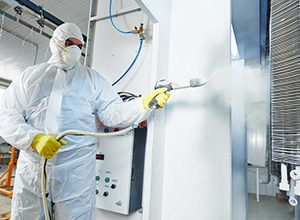
Trinity begins with an eight-stage electro deposition pretreatment process where the expanded metal panels are immersed in a liquid epoxy to thoroughly seal and encapsulate the carbon steel. Once E-Coated, we follow with a two-step TGIC polyester powder coat. Both the first color coat and the second, ultraviolet resistant clear coat are applied by the electrostatic method. The final finish is 8-12 mills thick.
| Exterior Durability, UV Stability | Good |
| Chemical / Solvent Resistance | Good |
| Corrosion Protection | Good |
| Chip Resistance | Good |
| Flexibility | Excellent |
Standard Poly-PRO is our most common economical coating option. This all around coating is great for interior or exterior applications. This coating uses an iron phosphate chemical wash and receives one spray coat of polyester powder.
| Exterior Durability, UV Stability | Poor |
| Chemical / Solvent Resistance | Excellent |
| Corrosion Protection | Excellent |
| Chip Resistance | Excellent |
| Flexibility | Excellent |
Epoxy coat is recommended for use in harsh interior applications. Epoxy coat offers the most chemical, chip resistance and corrosion protection of all the options – however, it is not UV stable.
HOT DIP GALVANIZING
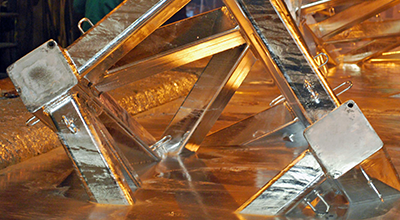
Hot Dip Galvanized, (HDG) is the process of dipping fabricated steel into a kettle or vat bath containing molten zinc. While the steel is in the kettle, the steel reacts with the molten zinc to form a tightly-bonded alloy coating that provides corrosion protection to steel. The bath chemistry is specified by ASTM B6, and requires at least 98% pure zinc maintained at 815-850 F (435-455 C). Expanded metal mesh from Niles is galvanized to ASTM-A123.
ANODIZING
Anodizing is an electrochemical process that converts the metal surface into a decorative, durable, corrosion-resistant, anodic oxide finish. Aluminum is ideally suited to anodizing, although other nonferrous metals, such as magnesium and titanium, also can be anodized.
The anodic oxide structure originates from the aluminum substrate and is composed entirely of aluminum oxide. This aluminum oxide is not applied to the surface like paint or plating, but is fully integrated with the underlying aluminum substrate, so it cannot chip or peel. It has a highly ordered, porous structure that allows for secondary processes such as coloring and sealing.